
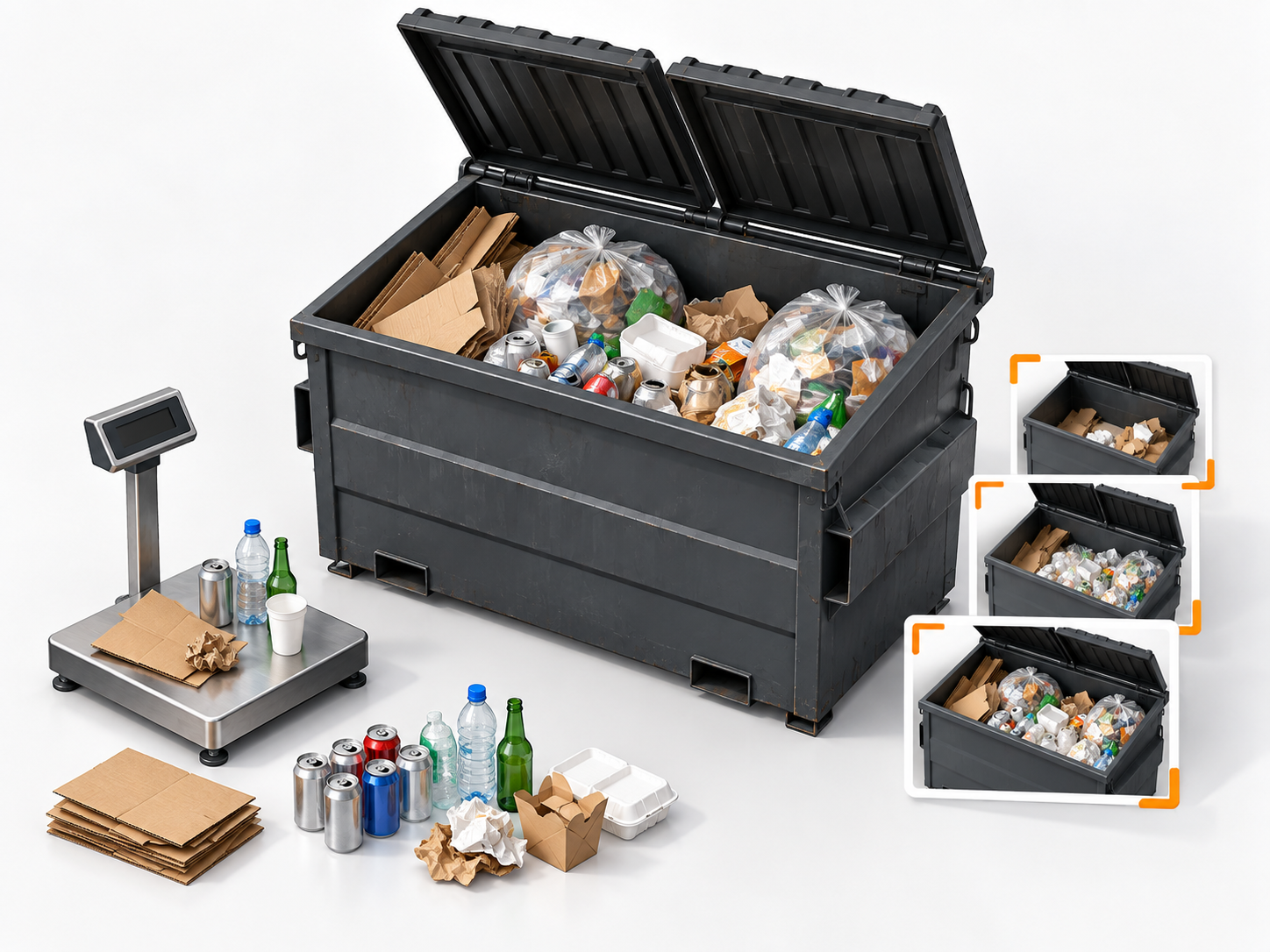
A commercial audit can also examine invoices, container size, pickup frequency, and repeated observations of dumpster use. This guide covers both sides: what is in your waste and whether your service matches what you generate.
Why do businesses conduct waste audits?
- Baseline: establish what you discard, where it comes from, and how much it costs.
- Cost reduction: find avoidable purchases, unused service capacity, and recurring extra charges.
- Contamination: identify items that do not belong in a recycling or compost stream.
- Compliance and certifications: gather evidence for local requirements or goals such as LEED and TRUE; confirm the specific program’s rules.
- Progress: track waste reduction and diversion instead of relying on impressions.
An audit provides evidence, not automatic improvements. Assign people to act on the findings and check the outcome. New York OGS explains this baseline-to-action approach.
What are the types of waste audits?
The EPA identifies three assessment methods. This guide adds monitored audits as a fourth practical option—not a universal classification.
- Records review
- Compare invoices, contracts, weight tickets, and service schedules. Start here for billing questions; records alone do not show what is inside a dumpster.
- Facility walk-through
- Observe bins, signage, storage, and staff practices. Use it to spot collection problems and plan sampling, not to claim precise material weights.
- Physical waste sort
- Collect, sort, and weigh a representative sample. Choose this for material composition and contamination measurements, including contents hidden in bags.
- Measured or monitored audit
- Observe container fullness and pickup activity repeatedly with sensors or cameras. Use it to evaluate service needs across days and weeks. Image-based material and weight estimates are not scale measurements.
How to conduct a waste audit: 6 steps
Use this process for ordinary non-hazardous workplace waste. Combine EPA’s assessment methods with a representative sample; the right audit window depends on your operations.
- STEP 1
Set goals and choose a representative period
Decide whether you need a diversion baseline, lower disposal costs, or both. Define the buildings, waste streams, and days covered. Include typical busy and quiet days; note holidays or unusual events rather than treating them as normal.
- STEP 2
Build your team and review records
Assign collection, sorting, weighing, and recording roles. Involve custodial staff and facilities managers. Gather invoices, contracts, weight tickets, container sizes, and pickup schedules. Walk through the facility to see where waste starts and where it ends up.
- STEP 3
Prepare categories, supplies, and a safe work area
Agree on categories before collection. Label bins, check scales, and record each empty container’s weight. Brief the team on handling rules. Coordinate with the hauler so the sample is not removed before the audit.
- STEP 4
Collect and sort representative samples
Keep trash, recycling, and organics samples separate and label their source and collection period. Sort ordinary non-hazardous materials into categories. Record items placed in the wrong stream. Do not change normal disposal habits just to improve the sample.
- STEP 5
Weigh, record, and calculate
Subtract empty-container weight from gross weight to find net waste weight. Use one unit throughout. Record each category, stream, date, and unusual finding. Calculate diversion and contamination separately; a sample describes the sampled period, not automatically the whole year.
- STEP 6
Report, act, and check again
Summarize the baseline and limits, then assign an owner and deadline to each change. Improve purchasing, bin labels, or service levels as the evidence supports. Compare later measurements and invoices with the baseline to see whether the changes worked.
Include normal operating days across a full business cycle where possible. A one-day sort is a snapshot; seasonal facilities may need repeat samples. Keep assumptions and unusual events in the final report.
Supplies and safety checklist
For a manual sort, gather suitable gloves, protective clothing, closed-toe footwear, task-appropriate eye protection, tarps, tables, tongs, labeled bins, a scale, data sheets, and a camera. Prepare handwashing and cleanup supplies.
Assess hazards first. Never enter dumpsters or compactors, reach blindly into bags, or handle sharps, unknown chemicals, or medical waste. Stop and involve trained specialists if these appear. Follow your workplace handling procedures.
No sign-up needed. Enter net weights in the worksheet; it does not calculate totals automatically. Government tracking sheets offer additional formats.
Which waste categories should you track?
Start with paper, cardboard, plastics, glass, metals, food and other organics, and residual trash. Split categories further when needed—for example, food scraps versus food-soiled packaging.
Record both the material and the stream where you found it. A cardboard box in trash is a possible diversion opportunity, not material already recycled. Confirm what your local processor accepts. Log hazardous waste, batteries, and e-waste separately for specialist handling; do not mix them into an ordinary sort.
How do you calculate diversion and contamination?
Diversion rate
Diversion rate = actually diverted weight ÷ total waste generated × 100. If 300 lb is accepted for recycling, 100 lb for composting, and 600 lb goes to disposal, total generation is 1,000 lb. Diversion is 400 ÷ 1,000 × 100 = 40%.
Use confirmed destinations and avoid double-counting. Recyclable material found in trash is a future opportunity, not current diversion. Program-specific reporting may define eligible destinations differently.
Contamination rate
Contamination rate = non-accepted material weight ÷ total sampled stream weight × 100. If a 200 lb recycling sample contains 20 lb of non-accepted material, contamination is 20 ÷ 200 × 100 = 10%. The denominator includes the contaminants.
These are worked examples, not customer results. Do not mix pounds with cubic yards or image estimates with measured weights. Label estimates separately, and confirm net weights by subtracting container tare weight. See OGS weighing guidance.
Waste audit rate calculator
Use the same weight unit and reporting period for both entries. Calculations stay in your browser.
Diversion rate: 40.0%
How does a measured or monitored waste audit work?
Z SIGHT captures dumpster images on a schedule and records service activity. AI analyzes those images to identify contents such as cardboard, glass, metal, plastics, trash, and organics, and estimate the proportion of each. Z SIGHT can also estimate weight.[2][9]
Two useful views of the same container
What goes into it
Material observations help reveal recyclables in the trash, organics that could be separated, and contamination that deserves attention.
How it gets used
Fullness and pickup patterns help evaluate container size and service frequency, and verify whether your provider is delivering the expected pickup service.
The customer process is straightforward:[2]
Install the monitor
Mount the preconfigured monitor on an eligible container.
Observe for 30 days
Continue normal operations while the monitor gathers observations.
Return and review
Return the monitor, receive your report, and evaluate the findings.
Your team does not need to organize a waste-sorting exercise to obtain this analysis.
Manual vs. monitored waste audits: what is the difference?
Both approaches can help identify materials and recycling opportunities. A hands-on sort measures a sample directly. Z SIGHT combines repeated observations of waste contents with fullness analysis and pickup verification across the audit period.
Swipe to view the full table.
| Comparison | Hands-on waste sort | Z SIGHT AI audit |
|---|---|---|
| Labor and best use | Requires a collection and sorting team; best for direct sample weights and detailed material categories. | Requires installation and return, not a sorting crew; best for recurring container-use and pickup patterns. |
| Collection method | People collect, sort, and weigh a sample. | A monitor captures images and service activity over the audit period. |
| Material analysis | Categories and measured weights for the sorted sample. | Identified material types, estimated proportions, and weight estimates. |
| Recycling opportunities | Findings from the materials physically examined. | Findings from observed materials and recurring patterns. |
| Time covered | The selected sample period. Audits can cover multiple days. | Scheduled observations across 30 days capture daily and weekly changes. |
| Pickup verification | Sorting and weighing alone do not verify whether expected pickups occurred. | Records pickup activity so actual service can be checked against the expected schedule. |
| Bagged materials | Staff can open bags during the sort to inspect their contents. | Analyzes visible materials. Clear bags can improve visibility during the audit. |
Methods: EPA waste-sort guidance, EPA sampling guidance, and Z SIGHT audit scope.
Z SIGHT can estimate weight as well as material proportions. These are estimates rather than scale measurements. A physical sort provides measured weights for the sampled materials.[10]
What should a waste audit report include?
A useful report states the scope, dates, sampling method, material findings, baseline service, and limits. Recommendations should show the evidence, estimated costs, an action owner, and a follow-up date. Monitored reports should also show fullness before pickups and activity against the expected schedule.
Illustrative example—not customer results
- Baseline
- A 6-yard dumpster collected three times weekly: 18 cubic yards of scheduled capacity.
- Observation
- Suppose readings immediately before pickups average 40% full over four weeks. That suggests spare capacity, but peak days and the longest gap between pickups still matter.
- Action to evaluate
- Ask for a two-pickup quote and model whether the container can hold the buildup between those days. Trial the change only if peak demand fits.
- Cost scenario
- If a comparable all-in quote falls from $400 to $320 monthly, annual savings would be ($400 − $320) × 12 = $960, before one-time costs. These are example prices, not a guaranteed result.
Explore the interactive sample waste audit report →
The sample page labels its observation periods and benchmark prices. Do not treat a sample report as a forecast for your business.
How can audit data change your dumpster service?
Container size: compare capacity with observed buildup before each pickup—not just average weekly volume. Leave room for busy days and confirm the enclosure, truck access, and available container sizes.
Pickup frequency: fewer collections can reduce cost if waste fits between visits. Check the longest gap, weekends, seasonal peaks, odor, and local collection requirements. A half-full container on one day is not enough evidence to cut service.
Overfill and contamination charges: compare dated observations with billed incidents. Ask the hauler for supporting records and acceptance rules. Better sorting or moving a pickup day may solve the problem more effectively than a larger dumpster.
Invoice review: reconcile scheduled and observed pickups, base rates, extra lifts, fuel or environmental charges, and renewal terms. Confirm a suspected missed pickup before requesting a credit. Quotes may not fall in direct proportion to fewer pickups.
Verify savings: compare like-for-like totals after the change, including recycling costs, taxes, extra charges, and one-time fees. Keep monitoring for overflow and service problems.
How much does a waste audit cost?
Pricing depends on facility size, the number of waste streams, and the scope of the engagement. Compare what is included rather than assuming every service called an “audit” is the same.[5]
DIY budget: staff hours × loaded hourly cost, plus supplies and cleanup. For example, four people working three hours at an assumed $25 per hour cost $300 in labor before equipment. This is planning arithmetic, not a market price range. A consultant’s quote also depends on travel, sample volume, sorting days, and reporting depth.
Swipe to view the full table.
| Type of audit | Published price | What it covers |
|---|---|---|
| Limited materials audit | From $485 | Renüable’s 24-hour audit categorizes and weighs waste and provides recommendations.[6] |
| Broader on-site consulting | $1,500–$5,000 | RMA’s audits cover handling practices, recordkeeping, and regulatory compliance, a different scope from a camera-based container audit.[7] |
| Invoice and contract review | Shared savings | Waste Consultants describes performance-based pricing: it receives 50% of savings found and says customers owe nothing if no savings are found.[8] |
These are provider examples, not a national average. Prices and scope vary. A lower price does not necessarily buy the same work.
Waste audit vs. assessment vs. free review
These names are used inconsistently. EPA uses “assessment” broadly enough to include a waste sort. In commercial offers, an assessment often means a walk-through and records review, while an audit may include measured samples and a detailed report.
A free review may be a municipal resource, introductory consultation, or sales proposal. Ask what data will be collected, who pays for the work, whether recommendations favor a provider, and whether fees or service commitments follow. Compare written scopes, not labels.
How often should you conduct a waste audit?
For routine planning, start annually; review every six months if waste changes quickly. Repeat after a major production, staffing, recycling, or service change. Use comparable seasons and methods so changes in your results mean something.
Between full audits, check invoices, contamination, and container use. Set an early follow-up after each service adjustment. Local mandates and certification rules may require a different scope or schedule.
Which waste audit is right for your business?
Start with the questions you need answered. If you want to understand your waste mix, find diversion opportunities, evaluate pickup needs, and verify service without arranging a manual sort, Z SIGHT offers a practical starting point.
Why the audit window matters
Waste needs change from day to day and week to week. A short analysis window may be insufficient to understand typical volumes, peak demand, and recurring service issues. Thirty days of observations help reveal those patterns and show how well your service matches them.
If you need precise material weights or evidence for a specific compliance program, choose a qualified physical-audit provider and confirm the required method. Records, sorting, and monitoring can complement one another.
Waste audit FAQs
What are waste audits?
Waste audits measure what an organization discards and how it manages those materials. A physical audit collects, sorts, and weighs samples; a broader review can include invoices, a facility walk-through, and monitoring. The results guide waste reduction, recycling improvements, and service decisions rather than guaranteeing savings.
What are the four types of waste audits?
For business planning, this guide groups the work into records reviews, facility walk-throughs, physical waste sorts, and monitored audits. This is a practical grouping, not a universal standard. EPA names the first three as assessment methods; repeated monitoring adds evidence about container use and pickup activity over time.
Can I conduct a waste audit myself?
Yes, for ordinary non-hazardous workplace waste when your team has the training, supplies, and safe space to do it. Start with the six steps and worksheet above. Use a qualified specialist for hazardous or medical waste, complex sampling, or an audit required by a regulator or certification program.
Are free waste audits available?
Some municipalities, recycling programs, and service providers offer free assessments or consultations. Ask whether the offer includes measured data and a written report or only a service quote. A shared-savings review may have no upfront fee but still charge a share of savings under a contract.
How often should waste audits be done?
For routine management, an annual audit is a useful starting point, with a six-month review if operations or waste volumes change often. Recheck after major service, staffing, production, or recycling changes. Any local legal requirement or certification-specific schedule takes priority over this general planning guidance.
How do I find waste audits near me?
Start with your local recycling office, commercial hauler, or an environmental consultant. Ask about methods, travel charges, sample size, report contents, and relevant experience. Remote monitoring is another option: Z SIGHT serves eligible U.S. businesses with 2–10-yard front-load dumpsters and cellular coverage, without an on-site sorting crew.
Do I have to change waste providers?
No. Buying a Z SIGHT audit does not require changing haulers or buying ongoing management. Use the findings to discuss your current service or compare alternatives. Confirm contract terms, available pickup days, fees, and actual quotes before making a change; an audit recommendation is not a new service agreement.
Put better information to work
Start your waste audit with ZTERS.
ZTERS has been in the waste and site-services business since 2009.[11] With Z SIGHT, we combine that experience with AI-assisted monitoring to help you understand your waste and decide what to do next.
You should not have to organize a sorting crew just to get a clearer picture of your waste.
Sources and further reading
Provider pricing examples reviewed October 3, 2026. Check each provider’s current scope and pricing when comparing options.
- EPA: Conducting waste assessments
- Z SIGHT: Audit kit, process, and eligibility
- EPA: Waste assessment approaches
- ZTERS: Guide to waste audits
- ZTERS: Waste audit and assessment services
- Renüable: Waste audit and consultation
- RMA: Waste audit cost and scope
- Waste Consultants: Waste and recycling audits
- ZTERS: Z SIGHT monitoring technology
- EPA: How to conduct a waste sort (PDF)
- About ZTERS
- New York OGS: Waste audit process and tracking sheets